
 EN
EN
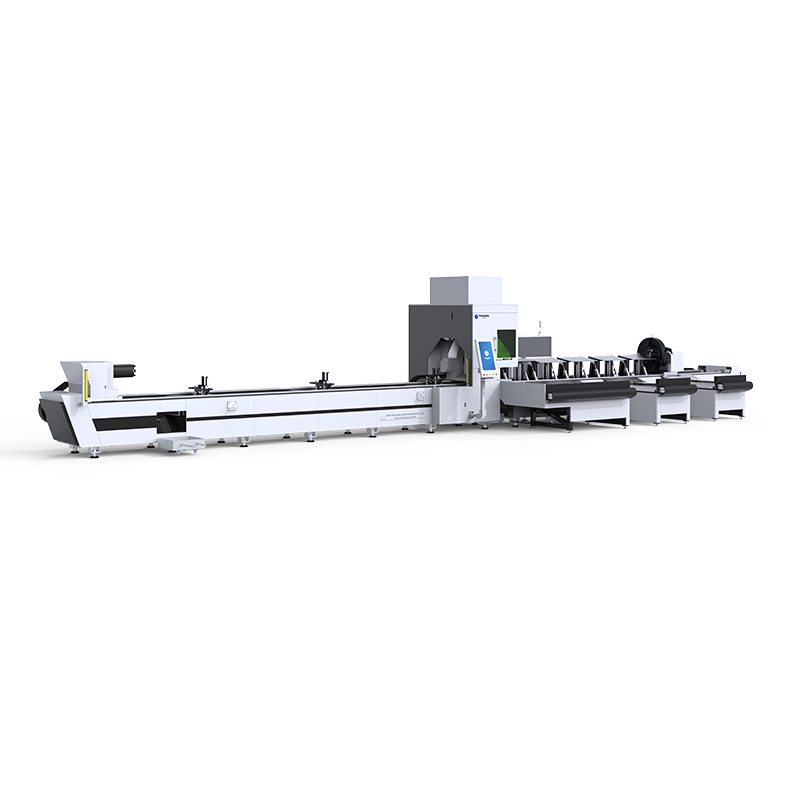
The Case for Single-Machine Processing of Multiple Material Forms
A fabrication shop cutting both sheet metal brackets and structural tube sections traditionally operates two separate machines — a plate cutting table and a tube cutting system — each requiring dedicated floor space, utility connections, operator attention, and maintenance. Sheet-and-tube combination laser cutting machines consolidate both functions into one machine platform, cutting flat plate from the main worktable and processing round, square, and rectangular tube sections through an integrated rotary chuck system.
The integration addresses the workflow problem that separate machines create. Plate parts cut on one machine must be transferred to assembly stations. Tube sections cut on another machine arrive at the same assembly stations through a different workflow path. When one machine finishes before the other, assembly stalls waiting for the missing component type. An integrated machine processing both forms delivers complete part kits to assembly simultaneously — the bracket and the tube it mounts to are cut in the same production sequence.
A steel furniture manufacturer producing office workstation frames switched from separate plate laser and tube sawing operations to an integrated sheet-and-tube fiber laser system. The previous workflow required cutting tube sections to length on a bandsaw, then milling end profiles for weld joint preparation. The integrated laser's tube module cut tube to length and profiled the end geometry — cope cuts for T-joints, miter cuts for corner connections — in a single operation, eliminating the milling step entirely. Total processing time per frame dropped from approximately 18 minutes to 7 minutes, and the single-machine footprint freed floor space later used for an additional assembly station.
Technical Integration of Plate and Tube Processing
Machine Architecture
Combination laser cutting machines mount the cutting head on a gantry that traverses the full length of the machine bed. For plate cutting, the head moves in X-Y across the flat worktable with Z-axis height following for focus control. For tube cutting, the gantry positions the head at the tube cutting station — typically mounted at one end of the machine frame — where a rotary chuck grips and rotates the tube while the head moves along the tube axis and radially to profile the tube surface.
The changeover between plate and tube mode takes 30–120 seconds — the plate cutting table loads or unloads while the tube station's automatic loader feeds the next tube section. This parallel operation allows near-continuous production with only the brief transition time between material forms.
The machine controller maintains separate parameter libraries for plate and tube cutting. The plate library stores speed, power, assist gas, and focal position for each material-thickness combination on flat sheet. The tube library adds rotary axis speed, profile geometry templates, and the pierce-start parameters that differ when the beam pierces a curved surface versus a flat surface.
Tube Processing Capabilities
The rotary chuck handles round tubes from 20mm to 220mm diameter and square/rectangular sections within equivalent limits. Tube lengths up to 6,000mm are processed with automatic loading; longer sections up to 9,000mm can be cut with manual loading or extended support.
The cutting head profiles tube ends for weld joint preparation — miter cuts at 15–75 degrees, cope cuts for T-joint welding, and slot features along the tube for interlocking frame connections. Hole patterns for bolt connections, cable routing, and drainage are cut depending on diameter and wall thickness. Pattern repeatability across batches eliminates fit-up variations from separate sawing and drilling.
Nesting Optimization
The nesting software optimizes both plate and tube simultaneously. Plate nesting achieves 75–85% utilization on automated software versus 60–70% manually. Tube nesting sequences parts along the length to minimize remnant material, with automatic spacing accounting for kerf width and the grip zone at each tube end.
Frequently Asked Questions
What is the cost difference between separate machines and a combination system?
A sheet-and-tube combination system typically costs 30–50% more than a plate-only machine but 20–30% less than purchasing separate plate and tube cutting machines. The single-machine savings extend beyond purchase cost — one foundation, one utility connection, one chiller, one dust collector, and one operator position rather than two of each.
Can an existing plate cutting machine be retrofitted for tube processing?
Retrofitting is technically possible but rarely cost-effective compared to purchasing an integrated system. The tube module requires a rotary axis, tube support system, and significant controller modification. Most fabricators find that trading in the existing machine for a factory-integrated combination system provides better results than field retrofitting.
How does tube cutting quality compare to sawing and machining?
Laser-cut tube ends are burr-free and weld-ready without secondary operations — eliminating the deburring and end-milling that sawing requires. The laser achieves profile accuracy of ±0.1mm on tube end geometry, comparable to CNC machining. Tianchen Laser's M230 three-chuck system maintains tube positioning accuracy throughout the cutting cycle.
What tube shapes and sizes can combination systems process?
Round, square, and rectangular sections are standard. Some systems also handle oval, D-profile, and channel sections with appropriate chuck jaw configurations. Maximum diameter ranges from 200–300mm depending on machine configuration. Tianchen Laser offers combination machines across the power range from 3kW to 12kW+.
How does the nesting software handle mixed plate and tube production?
The software manages separate nesting engines for 2D plate and 1D tube, presenting a unified production queue to the operator. Both material forms are processed from a single job file — the software automatically routes plate parts to the flat cutting table and tube parts to the rotary station based on part geometry.
What maintenance is specific to combination machines?
The tube station's rotary chuck requires lubrication of the chuck mechanism and linear bearings more frequently than the plate table — typically weekly for high-utilization systems. The protective bellows covering the tube station's linear ways require inspection for debris accumulation that can cause premature seal wear in environments with significant cutting dust.