
 EN
How Does a Laser Cutting Machine for Sheet Metal Adapt to Multi-Shape Processing?
Multi-shape production is where laser cutting earns its place on the shop floor. Enclosures, brackets, decorative panels, and prototype parts arrive as geometry rather than as families: tight internal radii, small holes, open profiles, and features that change with every revision. Punching and shearing need dedicated tooling for each profile, while a laser cutting machine for sheet metal produces any shape the software can describe, without dies and without the changeover time that tooling demands. That flexibility reshapes how shops quote, schedule, and deliver custom work, and it explains why multi-shape capability has become a baseline expectation rather than a differentiator.
Real-World Industry Case / Scenario
A Cabinet Shop Moving from Punch to Laser
An electrical enclosure manufacturer produced more than forty active product variants in batch sizes that rarely exceeded fifty units. Turret punching had served the shop for years, but every new variant meant tooling decisions, setup time, and inventory of punches and dies that only a few jobs used. Lead times stretched to two weeks for parts that spent most of that waiting on tooling availability rather than on production. The shop benchmarked a fiber laser cutting machine on a sample of its most complex variants, including panels with dense ventilation patterns and tight-radius profiles.
The benchmark demonstrated that the laser produced the complex profiles without tooling, and nesting software arranged the multi-shape parts across sheets with material utilization above what punching had achieved. The shop converted its production accordingly. Lead times for custom variants dropped from roughly two weeks to three days, since programming replaced tooling procurement. Small-batch and one-off jobs, previously unprofitable because of setup costs, became routine revenue. The machine also gained the shop revision flexibility: a design change required a file update rather than a tooling change, which mattered in a market where customers iterate quickly.
Risk & Failure Mode Analysis
Geometry Limits and Small Features
Multi-shape work pushes against physical limits that software cannot exceed. Minimum hole diameter relates to material thickness, and attempts to cut features below that relationship produce out-of-round holes and dross. Tight internal corners require the beam to slow, which adds heat and can round the corner. Very small parts may tip or weld to the sheet without micro-joint strategy. These limits are documented for each machine and material combination, and shops that design within them avoid scrap; shops that ignore them discover the limits through failed parts. Feature-level awareness belongs in the programming stage, not after the first nest is cut.
The flexibility of laser cutting shifts risk from tooling to programming. A nesting error that overlaps parts, ignores common-line opportunities, or misplaces micro-joints scraps an entire sheet, and on thin or coated material the cost per sheet is significant. Version control on part files matters as much as the cutting itself, since a revised drawing that reaches the machine without revision control produces parts to the wrong revision. Shops that standardize programming review, require documented material utilization per nest, and maintain file version discipline convert the flexibility of laser cutting into consistent output.
Technical Principles & Standard Compliance
2D, 3D, and Tube Cutting Capability
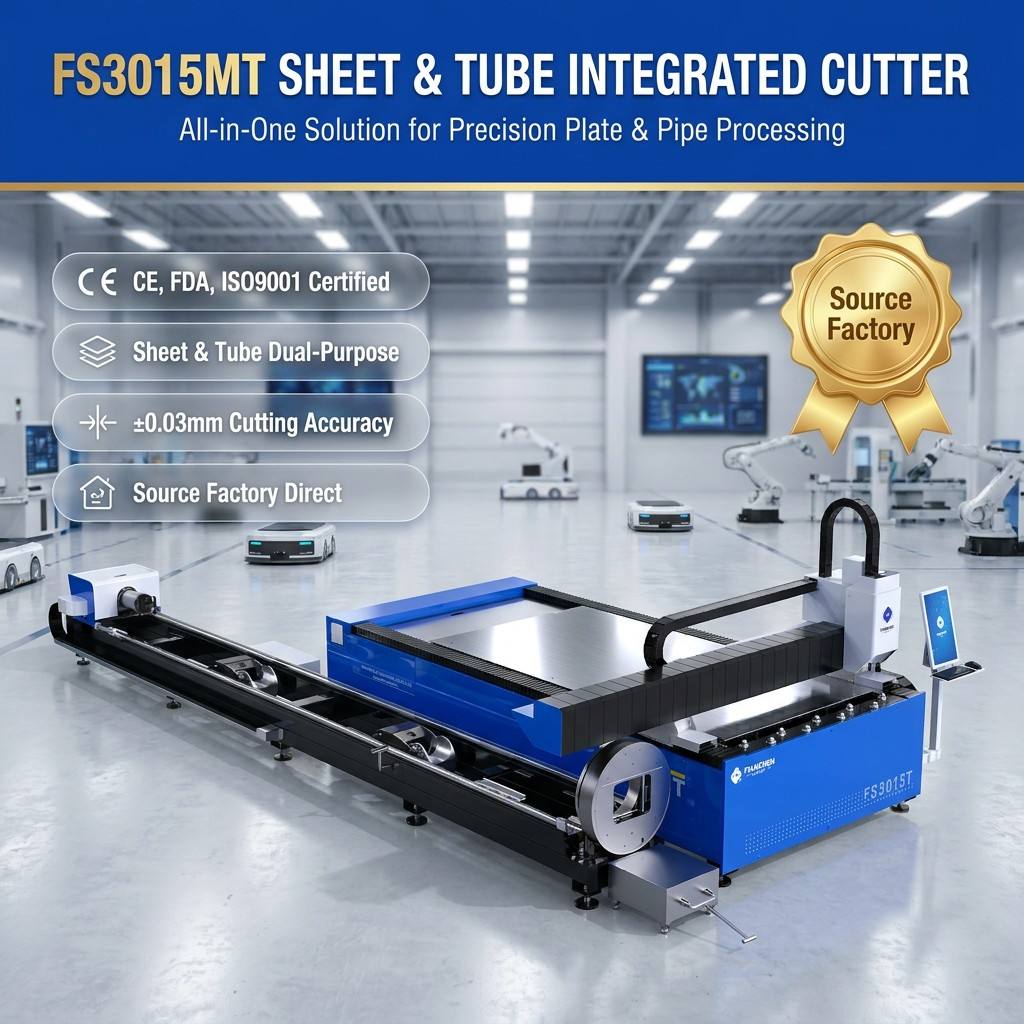
A laser cutting machine for sheet metal can be configured for flat sheet, and increasingly for structural and tubular work. Flat cutting heads with autofocus and capacitive height sensing handle diverse profiles across a sheet. Three-dimensional and tube cutting heads extend the same beam source to angled cuts on structural members and pipes, which opens fabricated assemblies that flat cutting cannot reach. The shared source means one laser cutting machine for sheet metal platform can serve both roles where the workload justifies it, and the control software coordinates the geometry regardless of configuration.
Software, Common-Line Cutting, and Tabs
Nesting software is the operational core of multi-shape production. Common-line cutting shares a single cut between adjacent parts, reducing total cut length and improving utilization on a laser cutting machine for sheet metal. Micro-joint tabs hold small or complex parts in place until removal, and their size and placement are tuned to material and geometry. Feature recognition, lead-in and lead-out strategies, and kerf compensation keep intricate profiles accurate. Safety and compliance requirements remain constant across configurations: ANSI Z136.1 for safe laser use, ISO 11553-1 for machine safety, and appropriate fume extraction for the materials processed. Machine suppliers such as Jinan-based Tianchen Laser support multi-shape production with application development, parameter libraries, and training that transfer the software capability to the shop's programming team.
Actionable Buyer & Maintenance Guide
Choosing a Laser Cutting Machine for Sheet Metal
Selection should follow the part mix. Shops producing flat profiles need robust 2D capability, strong nesting software, and fast axis response for short segments and tight geometry. Shops producing structural or tubular assemblies should evaluate 3D and tube configurations, where chuck design and rotation accuracy determine results. Verification points include cut quality on the buyer's most complex parts, minimum feature sizes demonstrated on actual material, material utilization achieved in test nests, and the documentation available for parameter libraries. A laser cutting machine for sheet metal should be benchmarked on demonstrated multi-shape output rather than on general specifications.
Keeping Multi-Shape Production Efficient
Multi-shape production consumes consumables at an uneven rate, because tight geometry and piercing-heavy parts stress nozzles and optics more than long straight cuts. Nozzle inspection intervals should reflect the actual part mix, and optics cleaning follows the contamination rate of the materials processed. Software maintenance matters as much as hardware: nesting libraries, parameter sets, and post-processors should be versioned and backed up, since a corrupted program set stops production as effectively as a mechanical failure. Recording utilization and cycle time per nest creates the baseline that identifies both software and hardware drift on a laser cutting machine for sheet metal.
Frequently Asked Questions
Question 1: What shapes can a laser cutting machine produce on sheet metal?
Answer: Any geometry the design file can describe, within documented physical limits. Minimum hole diameter, tightest internal radius, and smallest stable part relate to material thickness and machine capability, and these limits are published for each laser cutting machine for sheet metal and material combination. Profiles with dense small features, open contours, and tight radii are routine, provided the features stay within the documented limits for the material being cut.
Question 2: How does laser cutting compare with punching for multi-shape work?
Answer: Punching needs dedicated tooling for each profile, so setup time, tooling inventory, and changeover costs dominate small-batch production. A laser cutting machine for sheet metal produces any shape the software describes, without dies, which makes small batches and revisions economical. Shops with high-volume, simple profiles often keep both processes, using punching for repeat work and laser for variety.
Question 3: What is common-line cutting and why does it matter?
Answer: Common-line cutting shares a single cut between adjacent parts rather than cutting each part outline separately. It reduces total cut length, shortens cycle time, and improves material utilization, which lowers cost per part. Nesting software manages the geometry and tab placement that make common-line cutting safe on thin and coated materials, and utilization figures per nest should be documented and reviewed.
Question 4: Can one machine handle both flat and tube cutting?
Answer: Yes, where the workload justifies it. A laser cutting machine for sheet metal can be configured with 3D or tube cutting heads that use the same source, with chuck design and rotation accuracy determining tube results. Shops producing both flat parts and structural assemblies gain flexibility from a shared platform, though dedicated machines often deliver higher throughput on each configuration separately.