
 EN
Two Years in Pakistan: A 2024 Flatbed Still Cutting Scroll-Pattern Fence Panels
Dense curves and small apertures make kerf continuity the deciding factor in which orders a shop can accept. The customer has expressed the intention to buy a second machine when capacity expands.
In 2024, a customer in Pakistan purchased a flatbed laser cutting machine from Tianchen Laser. In a routine follow-up visit this October, the customer reported that cutting performance has remained stable to date, and expressed the intention to purchase another machine when capacity expands. No order has been placed yet.
The customer manufactures fencing, with a product line built mainly on ornamental scroll-pattern perforated panels. Orders of this kind share three characteristics: dense patterns, small apertures and continuous curves. Whether the kerf is complete decides whether the panel is usable at all.
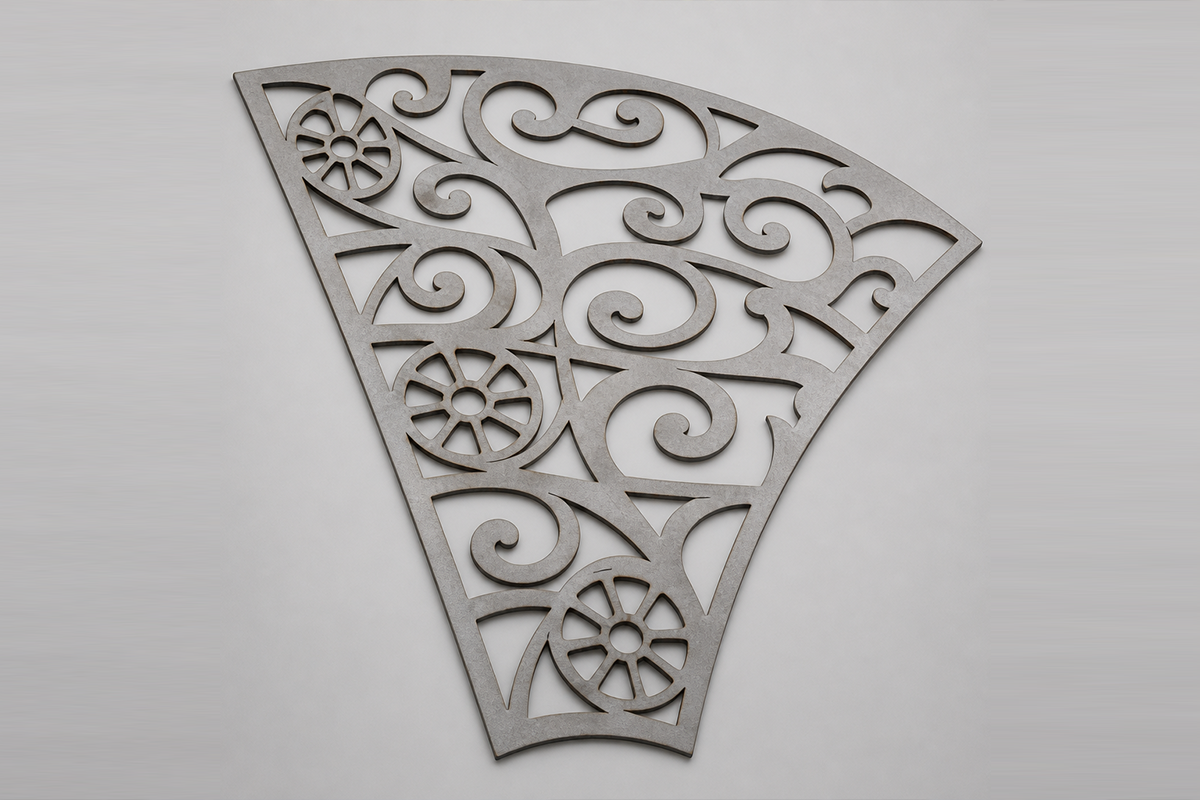
1. What he cuts is not a sheet, but ornament
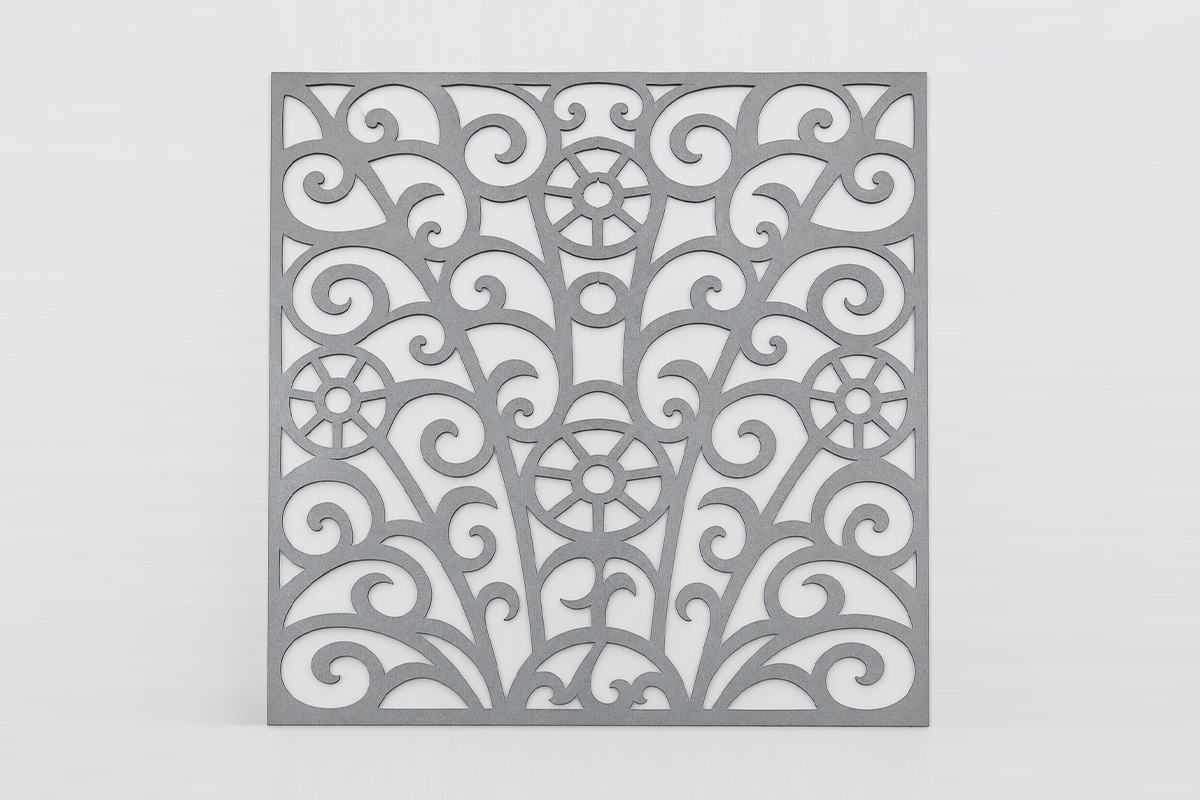
Fence panels look like plain sheet cutting. They are not. The product is a decorative panel perforated with scrollwork, leaf forms and continuous curves: between several dozen and a hundred closed apertures on a single sheet, with only a few millimetres of web left between them.
This is a different job from cutting machine frames or flanges. A frame is judged on straightness and throughput. Ornament is judged on whether each curve joins the next — one section left uncut scraps the whole panel; one section burnt leaves a mark that survives surface treatment.
Joining raises the bar further. Fence panels are rarely used singly; several panels form one continuous run, and the pattern has to carry across the joints. That requires consistent hole positions and consistent contour error across a batch. Holding tolerance on one part is not difficult. Holding it across a batch is.
2. Six steps from file to packed panel
From the process the customer described, a panel passes through six stages: drawing and sample approval, nesting and layout, laser cutting, deburring, surface treatment (galvanising or powder coating), and assembly and packing.
Laser cutting sits in the middle, and everything downstream depends on it. Cut badly, and the remaining five stages are wasted. Cut well, and the rest becomes simpler: a clean kerf needs no edge trimming, minimal dross needs no grinding, accurate holes need no on-site re-drilling.
This is why buyers in this trade do not ask how fast a machine runs. They ask whether the part still needs touching after it comes off the bed. Real capacity is decided by whether the part is finished when it leaves the machine.
3. Why thin sheet is harder than thick plate
A counterintuitive fact of this trade: 1.5 mm causes more trouble than 15 mm.
Thick plate is a question of power and gas — whether the machine has enough. Thin sheet is a question of control — whether it holds steady. Thin sheet has little thermal mass, so a small excess of heat input warps it. If energy is poorly controlled at the pierce, a single small hole distorts the material around it. And thin sheet has no stiffness to speak of: if fixturing and support are not fully in contact, the contour wanders.
Yield on thin ornamental work therefore depends far more on acceleration response, pierce strategy, corner control and bed rigidity than on the nominal power rating.
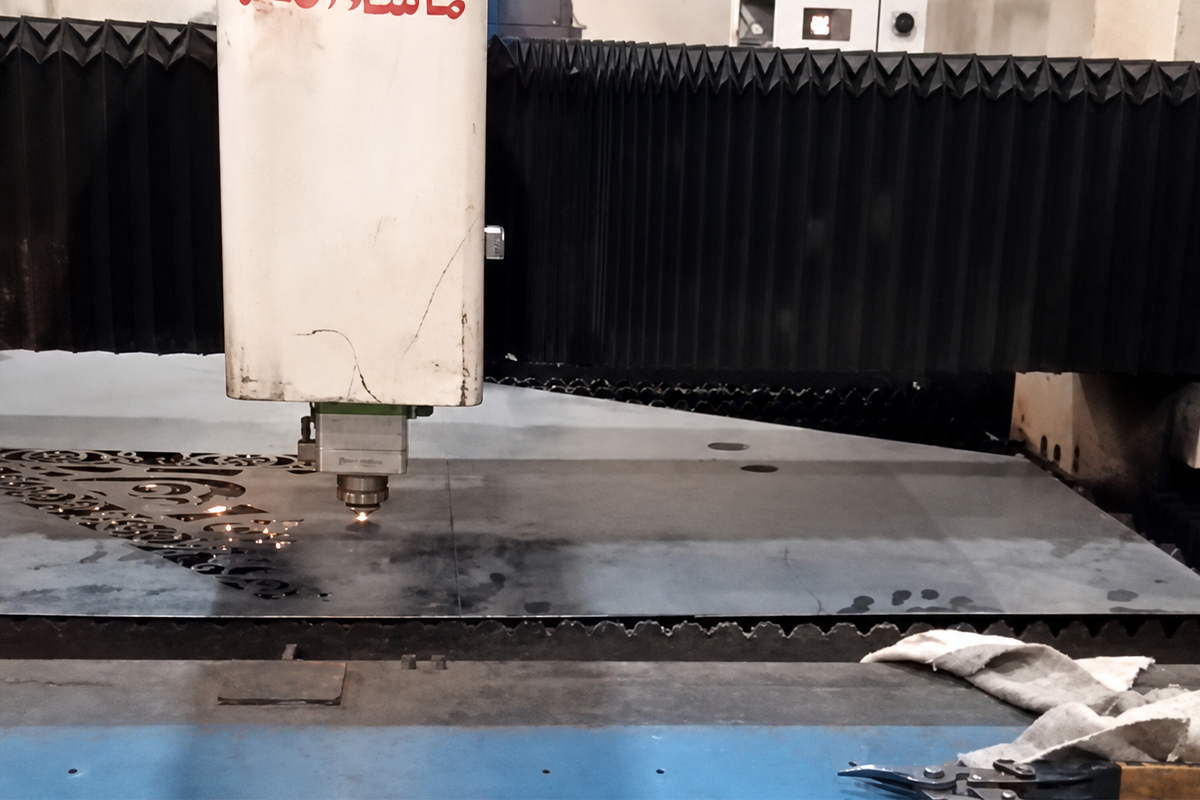
4. Where the difficulty actually sits
In scroll-pattern work, three points account for most defects.
Start and stop. The denser the curves, the more often the head accelerates and decelerates; every small aperture is one pierce and one termination. Many pierces accumulate heat, and thin sheet warps.
Narrow webs. With only a few millimetres between apertures, a slightly wide kerf damages the adjacent contour, while a slightly narrow kerf produces dross — and dross inside these holes cannot be reached with any tool.
Corners. Where a curve turns, mismatched acceleration leaves a rounded corner or a local burn. Fencing is a visible product: a softened corner still shows after coating.
Taken together, these three explain why, in quotations for ornamental work, "does it need hand finishing afterwards" often decides the margin more than gas and electricity do.
5. Nesting: this trade's margin hides in the layout
Perforated panels are inherently wasteful. On the same sheet, frame parts may yield over eighty percent, while ornamental panels may yield barely more than sixty — what is cut away is cost.
Layout therefore becomes a core operation: parts are rotated, offset and nested into each other's waste. But tight nesting has a price. Common-line cutting saves material yet sacrifices contour accuracy, and on parts with dense apertures and thin webs it can cut through a web outright.
The customer's approach is to tier by order: panels with high appearance requirements keep a margin, while internal structural parts are common-line cut. No machine makes that judgement for him — but whether a machine can hold common-line cutting, and whether it avoids burning at very narrow margins, decides whether he can use the strategy at all.
6. Three things that changed in two years
Work came back in-house. Complex patterns used to depend on subcontractors, or on hand work done piece by piece, with lead time and quality outside his control. All ornamental panels are now cut in his own plant.
Scheduling shifted from reactive to controlled. Subcontracting means queueing, and queueing means waiting for transport afterwards. In-house cutting puts the rhythm from order to dispatch under his own control. For fencing, where project deadlines are routine, this is often worth more than the saving on cost per part.
One process step disappeared. Small holes and narrow slots could not previously be ground: the tool would not reach, and forcing it distorted the thin sheet. Parts now pass directly to surface treatment. What disappeared with the grinding step was labour, subcontracting cost and waiting time.
7. Why "two years" is the measure, not the datasheet
A machine's factory figures prove what it can achieve. Its condition after two years proves whether it keeps achieving it.
These are not the same thing. The first can be obtained by careful setup on the day. The second depends on frame rigidity, rail wear resistance, optical stability and maintenance kept on schedule.
The two-year mark is worth recording because it crosses a set of things that change:
Lenses. Protective lenses degrade gradually through spatter and contamination, transmission falls, and the first symptom is thin sheet that will not cut through and speed that will not come up. Replaced on interval or not, the machine is in a different condition two years later.
Rails and racks. On high-acceleration machines, rail wear and lubrication bear directly on corner accuracy. Dense corner work shows wear earlier than straight cutting ever would.
The optical path. Collimation and focus drift are gradual. Nothing breaks suddenly; the kerf simply widens. Without a baseline record, it is hard to tell machine drift from parameters that need retuning.
The air supply. Pressure fluctuation and moisture are the quiet cause of thin-sheet defects, and they present as "one section will not cut through" in a position that keeps moving.
None of this is covered by a factory inspection. It only appears with time.
8. Why a follow-up visit needs a record
Tianchen runs customer follow-ups as a routine, and keeps three sets of data: the factory test-cut record, the installation and commissioning record, and the follow-up record.
The factory record captures the machine's condition at delivery — material, thickness, parameters, and what the cut looked like. The commissioning record captures its condition on site, connected to the customer's own air and power. The follow-up record captures its condition after a period of running.
Only the three together answer a specific question: what condition is this machine in now, and how far has it moved from delivery. Without the first two, the third is an isolated observation. With them, any failure to cut through can be traced to lens, air supply, optical path or parameters rather than guessed at.
For overseas customers the value is more direct: what can be judged remotely does not require an engineer to fly out.
9. The intention to buy again, and what it means
The customer expressed the intention to purchase another machine when capacity expands. No order has been placed.
The intention says something plainer than an order would: a machine that has run for two years is a machine the customer is willing to choose again when he grows. In a market where new equipment keeps getting cheaper and similar suppliers keep multiplying, that choice is not made on price.
For Tianchen, the value of this feedback is not in the order value either. It provides a sample that can be checked: in Pakistan, in fencing, on high-density scroll patterns, the machine has run continuously for two years.
10. Three points for buyers in the same trade
First, look at pattern density before power. In ornamental work the governing numbers are aperture size and web width, not maximum cutting thickness. Acceleration, corner control and small-hole pierce strategy affect yield more than the power figure does.
Second, put the downstream process into the cost. If panels still need hand trimming and grinding after cutting, that cost usually exceeds gas and electricity. Whether the kerf can go straight into surface treatment is something to verify on the machine, not in a brochure.
Third, insist on cutting your own drawing. Demonstration parts are selected. Bring the drawing you find hardest and look at corners and narrow slots.
Four checks settle cut quality on site: whether bottom dross wipes off with a finger, whether the kerf width matches top to bottom, whether corners carry a visible radius, and whether three consecutive parts stack into the same outline. None of these needs an instrument — a feeler gauge, a hand and a pair of eyes are enough.
About Tianchen Laser
Jinan Tianchen Laser Technology Co., Ltd. manufactures fiber laser cutting machines, laser welding machines and combined sheet-and-tube cutting equipment, serving the automotive, shipbuilding, steel structure, construction machinery, fencing and guardrail, kitchen equipment and sheet metal industries.