
 EN
EN
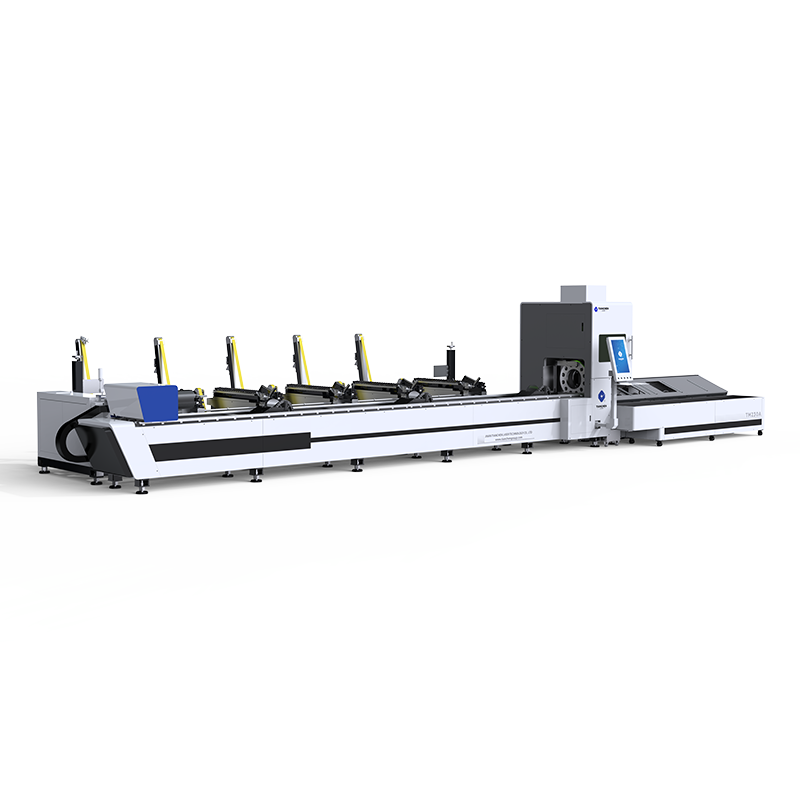
Laser Source Selection for Industrial Laser Cutting Machines: CO₂ vs Fiber in Automated Environments
Power Efficiency and Maintenance Impact on Unattended Operation
Automated laser cutting systems demand minimal intervention—making power efficiency and maintenance reliability decisive for unattended operation. Fiber lasers operate at 35–40% electrical efficiency, nearly double the 15–20% typical of CO₂ lasers. This translates to significantly lower energy costs—up to $740k annually per machine in high-volume facilities (Ponemon Institute, 2023). More critically, fiber lasers’ solid-state design eliminates gas replenishment, mirror alignment, and resonator purging—routine maintenance tasks that frequently interrupt CO₂-based unattended runs. As a result, fiber lasers achieve up to 95% uptime in 24/5 operations, compared to 78% for CO₂ systems, according to the Association for Manufacturing Technology.
| Parameter | Fiber Laser | CO₂ Laser |
|---|---|---|
| Avg. Power Efficiency | 35–40% | 15–20% |
| Maintenance Intervals | 2,000 hrs | 500 hrs |
| Unplanned Downtime | <2% | 8–12% |
Material-Specific Throughput Gains in High-Mix Production Workflows
Throughput in automated, high-mix environments depends less on peak power and more on wavelength-driven material interaction. Fiber lasers—emitting at 1μm—are strongly absorbed by reflective metals like stainless steel and aluminum, enabling up to 70% faster cutting than CO₂ lasers at thicknesses under 10mm. In contrast, CO₂ lasers (10.6μm) retain a 25% speed advantage on non-metallic materials such as acrylic, wood, and composites due to superior thermal coupling. For facilities processing diverse materials, deploying both technologies in parallel—fiber for metals (≈80% of jobs), CO₂ for organics—reduces changeover time by 40% and lifts overall equipment effectiveness (OEE) by 22 points in fully automated cells.
Automation-Critical Hardware Components of Industrial Laser Cutting Machines
Intelligent Cutting Head Systems: Autofocus, Height Sensing, and Collision Avoidance
Intelligent cutting heads are foundational to reliable autonomous operation. Real-time height sensing maintains ±0.05mm focal accuracy across warped or uneven sheet metal—critical for consistent edge quality without operator intervention. Integrated collision avoidance sensors detect unexpected obstructions (e.g., misloaded material or debris), halting motion before contact and preventing costly damage during unattended overnight cycles—the top cause of unplanned downtime in automated shops. Autofocus functionality further enhances flexibility, allowing seamless transitions between multi-thickness stacks without manual recalibration—cutting material changeover time by 23% versus conventional heads.
CNC Control Architecture: Proprietary vs Open-Platform Integration for Reliable Automation
The CNC control system governs automation resilience—not just motion but synchronization, diagnostics, and data fidelity. Proprietary architectures deliver tightly tuned laser-motion coordination, especially vital for high-speed, reflective-metal cutting where timing errors cause burn-through or dross. Open-platform controls—built on OPC UA and MTConnect standards—offer superior interoperability with ERP and MES systems, enabling real-time job dispatch, status reporting, and predictive maintenance alerts. While proprietary systems achieve 99.95% command execution reliability, open platforms reduce integration effort and cost by 40% across heterogeneous production lines. Crucially, operational studies show automation viability collapses when servo response exceeds 500ms—confirming that processing architecture is not merely an interface concern, but a core uptime determinant.
Production Scale Alignment: Matching Automation Features to Volume, Mix, and Uptime Goals
Dual Exchange Tables vs. Robotic Loading: ROI Thresholds by Monthly Part Count and Labor Cost Profile
Automation ROI hinges on aligning hardware capability with actual production scale—not theoretical capacity. Dual exchange tables eliminate idle time by loading the next sheet while the current one cuts, delivering strong value for mid-volume, moderate-labor-cost operations (5,000–15,000 parts/month). Robotic loading, however, becomes economically compelling above 20,000 parts/month—or wherever labor exceeds $30/hour—due to its ability to sustain true 24/7 material handling. A benchmark study across 42 automated facilities found robotic systems achieved 92% uptime versus 78% for dual tables in continuous operation. Strategic alignment looks like this:
- Low-volume/high-mix shops (<8,000 parts/month) gain agility and lower risk with dual tables’ simplicity
- High-volume production requires robotic throughput consistency to meet takt time targets
-
Labor-intensive environments should prioritize robotics where wage premiums justify capex—especially where regional labor shortages constrain scalability
This tiered approach prevents over-engineering while ensuring automation delivers measurable throughput and uptime gains.
Shop-Floor Integration Readiness for Industrial Laser Cutting Machines
Standardized Connectivity (OPC UA, MTConnect) and ERP/MES Gateway Requirements
True shop-floor integration begins with standardized, vendor-agnostic connectivity—not retrofitting or custom middleware. Industrial laser cutting machines must natively support OPC UA and MTConnect to enable secure, real-time bidirectional data exchange with factory networks. These protocols unify machine states (running/idle/alarm), process parameters (power, speed, gas pressure), and quality events (pierce failures, torch collisions) into a single data stream. When paired with certified ERP and MES gateways, this infrastructure synchronizes production scheduling with material availability, tool wear tracking, and first-article inspection workflows—reducing manual data entry and reconciliation by 30–50%. Facilities adopting unified connectivity report 25% faster changeovers during high-mix production, per the 2023 Automation Efficiency Benchmark.
FAQ Section
What is the main advantage of fiber lasers over CO₂ lasers in automated laser cutting?
Fiber lasers offer higher power efficiency and lower maintenance needs compared to CO₂ lasers, resulting in higher uptime and lower operational costs.
How do fiber lasers and CO₂ lasers differ in processing materials?
Fiber lasers excel at cutting metals due to their wavelength absorption characteristics, while CO₂ lasers perform better on non-metallic materials due to their thermal coupling.
Why is CNC control architecture important for automation?
CNC control architecture impacts motion synchronization, diagnostics, and data fidelity, which are crucial for achieving reliability and uptime in automated environments.
Table of Contents
- Laser Source Selection for Industrial Laser Cutting Machines: CO₂ vs Fiber in Automated Environments
- Automation-Critical Hardware Components of Industrial Laser Cutting Machines
- Production Scale Alignment: Matching Automation Features to Volume, Mix, and Uptime Goals
- Shop-Floor Integration Readiness for Industrial Laser Cutting Machines
- FAQ Section