
 EN
EN
In the fast-paced world of metal processing, technological innovations are constantly reshaping the industry landscape. Among these advancements, fiber laser technology has emerged as a game-changer, revolutionizing how metal cutting, welding, and other processing tasks are performed. For enterprises like Tianchen Laser, a high-tech enterprise founded in 1995 and specialized in the research, development, production, and sales of intelligent metal forming equipment, fiber laser technology has become a core driving force behind its ability to provide global customers with top-notch metal forming and automated production line solutions. With an intelligent manufacturing base boasting an annual production capacity of over 10,000 units for main products and a business footprint spanning more than 100 countries and regions, Tianchen Laser’s success is closely tied to the unique advantages of fiber laser in metal processing. Let’s delve into the key factors that make fiber laser stand out in this field.
Unmatched Technical Superiority: Precision and Adaptability
Fiber laser technology excels in technical aspects that are crucial for metal processing. One of its most notable features is its wavelength. The wavelength of fiber laser is around 1070 nm, which is only one-tenth of the wavelength of traditional CO₂ lasers. This shorter wavelength brings a significant advantage in terms of material absorption. For instance, low-carbon steel, a commonly used metal in various industries, absorbs less than 10% of CO₂ laser energy, while its absorption rate of fiber laser energy can reach as high as 35%. This high absorption rate means fiber laser can efficiently process even high-reflectivity metals like aluminum and copper, which were once challenging for traditional laser technologies. Tianchen Laser leverages this advantage to develop a full range of metal cutting machines, such as the cost-effective NS3015 and the high-performance PM3015, ensuring that customers in different industries can handle diverse metal materials with precision.
Another technical highlight of fiber laser is its excellent beam quality, measured by the Beam Parameter Product (BPP). A lower BPP value indicates better beam quality, and fiber laser typically has a very low BPP value. Except for the 5 - 10kW power range where it is slightly inferior to CO₂ lasers, fiber laser outperforms other laser types in most power ranges. This superior beam quality allows fiber laser to focus into a small spot, achieving high brightness and a long focal depth. As a result, it can work at a long distance, enhancing its adaptability in material processing. Whether it is cutting thin metal sheets with intricate patterns or thick metal plates for heavy machinery parts, fiber laser ensures high cutting precision. Tianchen Laser, adhering to a quality - and service - oriented approach, integrates this excellent beam quality into its products, enabling its laser cutting machines to meet the strict precision requirements of industries like automotive manufacturing and construction machinery.
Exceptional Efficiency: Boosting Productivity
In the competitive metal processing industry, efficiency is a key factor that determines an enterprise’s competitiveness. Fiber laser technology shines in this aspect, offering remarkable efficiency advantages. Thanks to its high beam quality and high power density, fiber laser cutting speed is significantly faster than that of traditional lasers. When cutting stainless steel thin sheets, the cutting speed of fiber laser can be 2 - 3 times that of CO₂ lasers with the same power. For example, a 2kW fiber laser cutting system can cut 0.5mm carbon steel at a speed of up to 40 meters per minute. Even when processing 6mm thick materials, a 1.5kW fiber laser cutting system can match the cutting speed of a 3kW CO₂ laser cutting system. This high speed directly translates to increased productivity for manufacturers. Tianchen Laser’s large - format FB12525 laser cutting machine, equipped with advanced fiber laser technology, is ideal for industrial projects requiring large - scale metal cutting. It combines power and precision to help customers complete large - volume processing tasks in a shorter time, aligning with Tianchen Laser’s commitment to providing efficient solutions for global customers.
The efficiency advantage of fiber laser is not limited to cutting. In welding, fiber laser also performs exceptionally well. It enables continuous oscillation, resulting in smooth welding seams. The excellent beam quality reduces the heat input during welding, minimizing material deformation. Compared with traditional welding techniques like Gas Metal Arc Welding (GMAW) and Gas Tungsten Arc Welding (GTAW), fiber laser welding is much faster. It can be up to 5 times faster than GMAW and 10 times faster than GTAW. This high welding speed significantly shortens the production cycle, allowing manufacturers to deliver products to the market more quickly. Tianchen Laser, with its focus on customer - centered services, develops laser welding equipment that incorporates these efficiency features, helping customers in industries such as agricultural machinery and automotive manufacturing improve their production efficiency and gain an edge in the market.
Cost - Effectiveness: Reducing Operational Burden
For any enterprise, cost control is essential for sustainable development, and fiber laser technology offers significant cost - saving benefits in metal processing. One of the main cost advantages is its high electro - optical conversion efficiency. Traditional CO₂ lasers have an electro - optical conversion efficiency of less than 10% because their optical paths rely on mirrors for transmission, leading to rapid optical path attenuation and significant energy loss. In contrast, fiber laser has an electro - optical conversion efficiency of up to 30%. This high efficiency greatly reduces electricity consumption during operation, lowering the daily operating costs of equipment. Tianchen Laser, with its annual production capacity of over 10,000 units, ensures that its fiber laser - based products are cost - effective, helping customers reduce long - term operational expenses.
In addition to lower energy costs, fiber laser also has lower maintenance costs. CO₂ laser systems have a complex structure, requiring regular maintenance of mirrors and resonant cavities. The replacement of turbine bearings is also expensive. On the other hand, fiber laser cutting machines use optical fibers for transmission, eliminating the need for complex light - guiding systems like mirrors. The optical path is simple and stable, and the external optical path requires no maintenance. The mean time between failures (MTBF) of fiber laser equipment exceeds 100,000 hours, and there are basically no consumables. This means manufacturers can save a lot on maintenance fees and avoid production downtime caused by equipment maintenance. Tianchen Laser, with its 29 - year history of rapid growth, understands the importance of cost - effectiveness for customers. By promoting fiber laser products, it helps customers reduce the total cost of ownership and improve their profit margins.
Flexibility: Adapting to Diverse Needs
The metal processing industry serves a wide range of sectors, each with unique processing requirements. Fiber laser technology’s high flexibility makes it well - suited to meet these diverse needs. Traditional CO₂ laser cutting machines have large volumes due to their mirror - based optical paths, requiring a lot of space. They also have high requirements for machine frames and guide rails, making it difficult to achieve large - format and multi - dimensional cutting. In contrast, fiber laser transmits laser beams through optical fibers to the laser head, eliminating the need for optical path adjustment. This simplifies the design of the mechanical system, making the cutting system more compact. Tianchen Laser’s PS3015 low - power laser cutting machine, for example, is designed with this compact feature, making it suitable for small - and medium - sized enterprises with limited workshop space.
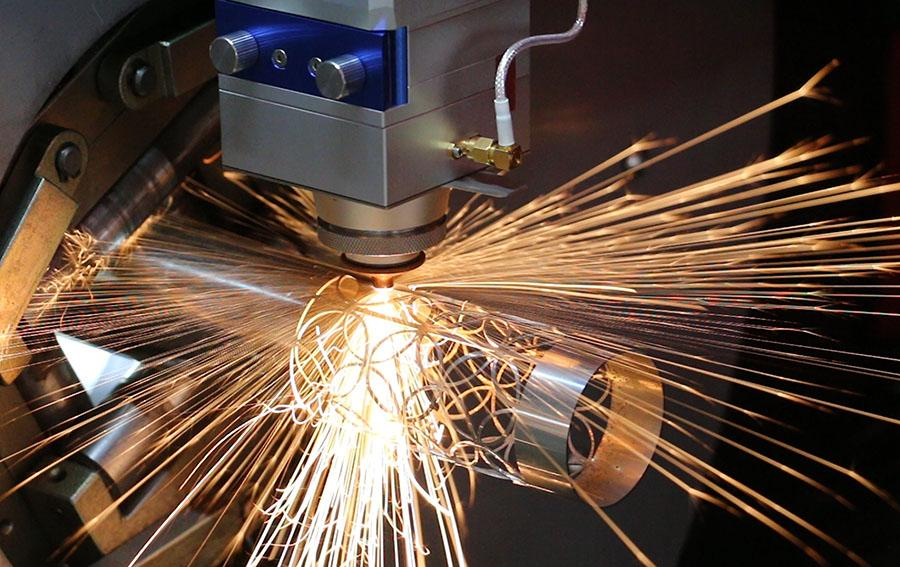
Fiber laser’s flexibility is further reflected in its ability to process various shapes and types of materials. It can cut arbitrary patterns and process pipes and other special - shaped materials. It is also suitable for multi - dimensional processing in any space, providing broad development space for the application of 3D laser cutting technology in automotive body manufacturing. The integration system of fiber laser and industrial robots has already been applied in engineering, enabling automated and flexible production. Tianchen Laser, which provides one - stop industrial laser machine solutions, offers customized fiber laser solutions according to the specific needs of customers in different industries. Whether it is the automotive manufacturing industry’s demand for precision cutting of auto parts or the construction industry’s need for large - size metal component processing, Tianchen Laser’s fiber laser products can adapt to these diverse requirements, demonstrating its strength as a leading enterprise in the laser industry.
In conclusion, fiber laser technology stands out in metal processing due to its technical superiority, high efficiency, cost - effectiveness, and flexibility. Tianchen Laser, with its long - standing commitment to quality and customer service, has fully harnessed these advantages of fiber laser. Over the past 29 years, it has grown into a global provider of metal forming and automated production line solutions, serving customers in more than 100 countries and regions. As the metal processing industry continues to evolve, fiber laser technology will undoubtedly play an even more important role, and Tianchen Laser will remain at the forefront of this technological revolution, continuously providing innovative and efficient solutions for global customers.